How much does a spray drone cost in Australia? (2026 buyer's guide)
What a DJI Agras spray drone actually costs in Australia in 2026, what a working kit includes, and the licence, training and insurance costs that never make it into the headline price.

Short version
- A working DJI Agras spray drone kit in Australia starts in the low-to-mid $40,000s inc GST for a T50 and the high $40,000s for a T100, delivered, commissioned and with training. Bare aircraft are cheaper; bare aircraft are also not a working system.
- Budget separately for your licence, chemical accreditation, insurance and extra batteries. Together they can add several thousand dollars in year one.
- Anything over about $7,000 on our store is quote-only, because the right kit depends on your paddocks, not a shopping cart.
If you've searched "spray drone cost Australia" you've probably found one of two things: a bare aircraft price with nothing else, or a page that says "contact us" and nothing at all. Neither helps you budget. This guide sets out what the gear actually costs, what has to come with it before it will spray a paddock, and the costs that sit outside the box.
Prices here are our base kit prices at the time of writing, in Australian dollars and inclusive of GST. They move with exchange rates and DJI's pricing, so treat them as a guide and ask for a written quote before you plan around them.
What a spray drone kit costs in 2026
| Kit | What it's for | Base kit, inc GST |
|---|---|---|
| DJI Agras T50 Precision Spraying Kit | The proven entry point for most Australian farms | from $43,208 |
| DJI Agras T50 Spreading Kit | Granular fertiliser, seed and bait | from $45,408 |
| DJI Agras T100 Precision Spraying Kit | When hectares per day is the constraint | from $47,518 |
| DJI Agras T100 Spreading Kit | Heavy spreading loads | from $49,278 |
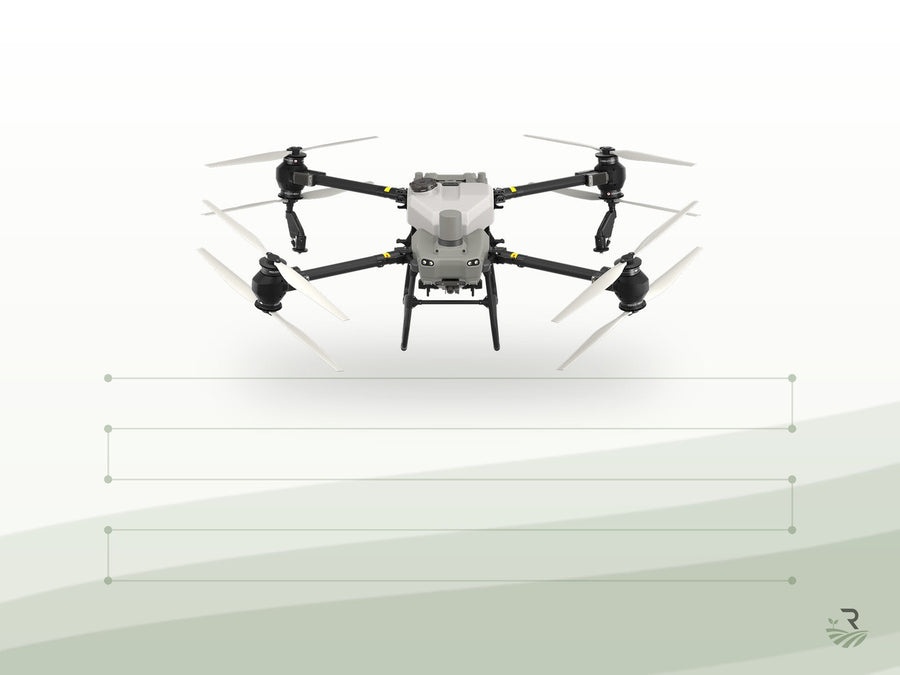
Two things stand out. First, the gap between the T50 and the T100 is smaller than the difference in what they carry, which is why people jump to the T100 without thinking about whether they need it (we cover that in Agras T50 vs T100). Second, these are kit prices, not aircraft prices. A kit is what it takes to go and spray.
What "kit" means, and why a bare aircraft isn't one
An Agras aircraft on its own will not spray a paddock. It needs batteries (plural), a generator-capable charger, a controller, and for spraying work an RTK base station so the drone knows where it is to within a few centimetres. Then someone has to set it up, test it, and teach you to fly it.
Our spraying kits include the aircraft with spray system, the RC Plus 2 controller, the charger, a set of flight batteries, and an RTK base station. The T50 kit ships with the D-RTK 2 base; the T100 kit ships with DJI's newer RTK 3 Ag mobile station. Every drone package we sell also includes delivery to your farm, commissioning, flight testing, hands-on operator training, CASA guidance before you buy, ongoing phone support and local servicing.
The honest bit
Our spreading kits do not include an RTK base station. Spraying needs RTK because drift and overlap control depend on tight positioning; spreading is more forgiving. If you'll do both jobs with one aircraft, buy the spraying kit and add the spreading system rather than the other way around.
How many batteries you actually need
This is the number that catches people. A T50 flight battery is a 30,000 mAh pack and a full 40 L tank comes back for a swap in a matter of minutes. On the T100 you're moving 100 L a load through a 41,000 mAh pack. In practice a spray day is a rotation: one battery flying, one charging, one cooling.
Three batteries is the working minimum for a proper day. If you're planning long runs or you're spreading heavy loads, four is more comfortable. Extra batteries are one of the first things people add after the first season, so budget for them now rather than being surprised later.
The costs outside the box
None of these come from us and none of them are optional if you want to spray legally.
Your licence. An Agras T50 has a maximum take-off weight of 92 kg spraying. That puts it in the 25 to 150 kg category, which means a Remote Pilot Licence (RePL) even on your own land, with the aircraft type listed on it. If you'll spray for other people you'll need to operate under a Remote Operator's Certificate (ReOC) as well. Training providers set their own prices; ask for the all-in figure including the type-specific endorsement. We walk through this in Can I legally fly a spray drone on my own farm?
Chemical accreditation. Every state has its own rules for applying agricultural chemicals from an aircraft. Victoria issues its own RPA pilot (chemical rating) licence and RPA agricultural aircraft operator licence through Agriculture Victoria. Other states use their own permits and training. Ask your state agriculture department what applies before you book a course.
Insurance. Hull insurance on a $40,000-plus aircraft and public liability for aerial application are both worth getting quoted before you buy. Some insurers want to see your licence and your operations paperwork first.
Consumables and servicing. Nozzles, propellers and pump parts wear. Plan an annual service.
Finance. Equipment finance is available for ABN holders. We don't publish repayment figures here because they depend on your circumstances and the broker's terms.
Why we quote instead of listing an Add-to-cart button
Every product on our store over roughly $7,000 is quote-only. That's deliberate. The right kit for 300 hectares of undulating pasture is not the right kit for 3,000 hectares of flat cropping, and the difference is usually a battery count, a base station and sometimes a smaller aircraft than you were going to buy.
When you request a quote we'll ask what the job is, where the country is and how many hectares you're covering, and we'll come back within one business day with an itemised price. If the cheaper kit is the right one, that's what we'll quote.
Second-hand spray drones: worth it?
Sometimes. The things to check are battery cycle counts (packs are a big part of the value), whether the aircraft has had a hard landing, whether it's registered with CASA in a way you can transfer, and whether you can get it serviced locally. A second-hand aircraft with tired batteries and no support can cost more than a new kit by the end of the first season. If you're looking at one, we're happy to tell you what to check.
Common questions
How much is a DJI Agras T50 in Australia?
Our T50 Precision Spraying Kit starts from $43,208 inc GST as a base kit, including the aircraft, controller, charger, batteries, D-RTK 2 base station, delivery, commissioning and training. The bare aircraft is cheaper but is not a working system.
Is the T100 much more expensive than the T50?
As base kits, the difference is a few thousand dollars. The bigger question is whether you need the extra capacity and whether you can operate it at full load under your licence, which we cover in the T50 vs T100 guide.
Can I get finance on a spray drone?
Equipment finance is available for ABN holders. Ask us for a quote and we'll put you in touch with the broker for repayment figures.
Do I need a licence to fly a spray drone on my own farm?
For an Agras-sized aircraft, yes. Aircraft between 25 and 150 kg need a RePL even over your own land. Confirm the current position with CASA or a compliance advisor before you buy.
Sources
- DJI Agras T50 and T100 specifications, ag.dji.com
- Agriculture Victoria, "Drone or remotely piloted aircraft spraying" and "Licences for drone or remotely piloted aircraft spraying of agricultural chemicals"
- CASA, drone weight categories and remote pilot licence requirements, casa.gov.au
Written quote within one business day. Delivery, training and CASA guidance included.
A spray drone is a $40,000-plus decision. Here's how to work out whether it beats the boom, beats the contr...
Read
A thermal drone finds warm bodies in cold country and spots a leaking trough from the air. It also goes bli...
Read
A camera measures the treetops and guesses at the ground. LiDAR sees through the canopy to the dirt. Here's...
Read